





PS Simul software, created primarily to allow users to model a wide range of complex power system and control components and to simulate electromagnetic and electromechanical transients, offers a highly intuitive and user-friendly interface. It includes a series of features that simplify data entry, as well as result acquisition and evaluation.
In addition, PS Simul provides its users with a library containing more than 400 elements. Among the models that enable studies involving traveling waves in transmission lines, the following stand out: transmission lines represented by several models (Bergeron, frequency-dependent phase-domain or modal modeling, among others), filters with different topologies, and the Bewley/Lattice diagram for traveling-wave analysis, among others.
Next, part of the theory related to traveling-wave fault location will be discussed, and a study made possible by the resources and components of PS Simul software will also be presented. The study is available in the FREE version of the software and can be accessed through the “Support -> Examples” tab. This allows you to open the example, check the simulation parameters used, and view the available waveforms. To download the FREE version and access these examples, use the link below:
TRAVELING-WAVE FAULT LOCATION
The concept of traveling waves applied to fault location can be better understood using the Bewley/Lattice diagram, shown in the figure below.
Attachment:

File comment: Fig. 1 – Bewley/Lattice diagram for traveling-wave analysis.
The diagram shows that the occurrence of a fault (short circuit) produces voltage and current waves that propagate from the fault point in both directions along the transmission line. As soon as these waves encounter new discontinuities, they are reflected and return to the fault point, where new reflections and refractions occur.
Thus, it is possible to estimate the distance of a fault relative to measurement terminal A up to the first half of the transmission line by:
d=(T2−T1)⋅v2
Where:
- v -> wave propagation velocity
- T1 -> propagation time of the first wavefront from the fault point to terminal A
- T2 -> propagation time of the first wave, measured after the second reflection, at the fault point and from that point back again to measurement terminal A
Typically, the difficulty in traveling-wave fault location is identifying the second reverse wavefront reflected at the measurement point, since under real conditions the transient signal being analyzed contains noise.
PRACTICAL EXAMPLE OF TRAVELING-WAVE FAULT LOCATION
This example aims to present the concept of fault location through the analysis of traveling waves in transmission lines. As already explained, after a fault occurs on a transmission line, voltage and current waves propagate in both directions along the line. When they encounter a new discontinuity, these waves are reflected and return to the fault point, where new reflections and refractions occur.
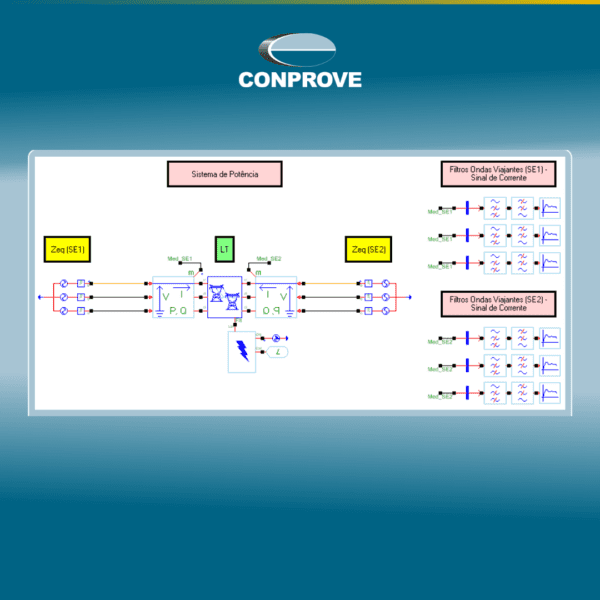
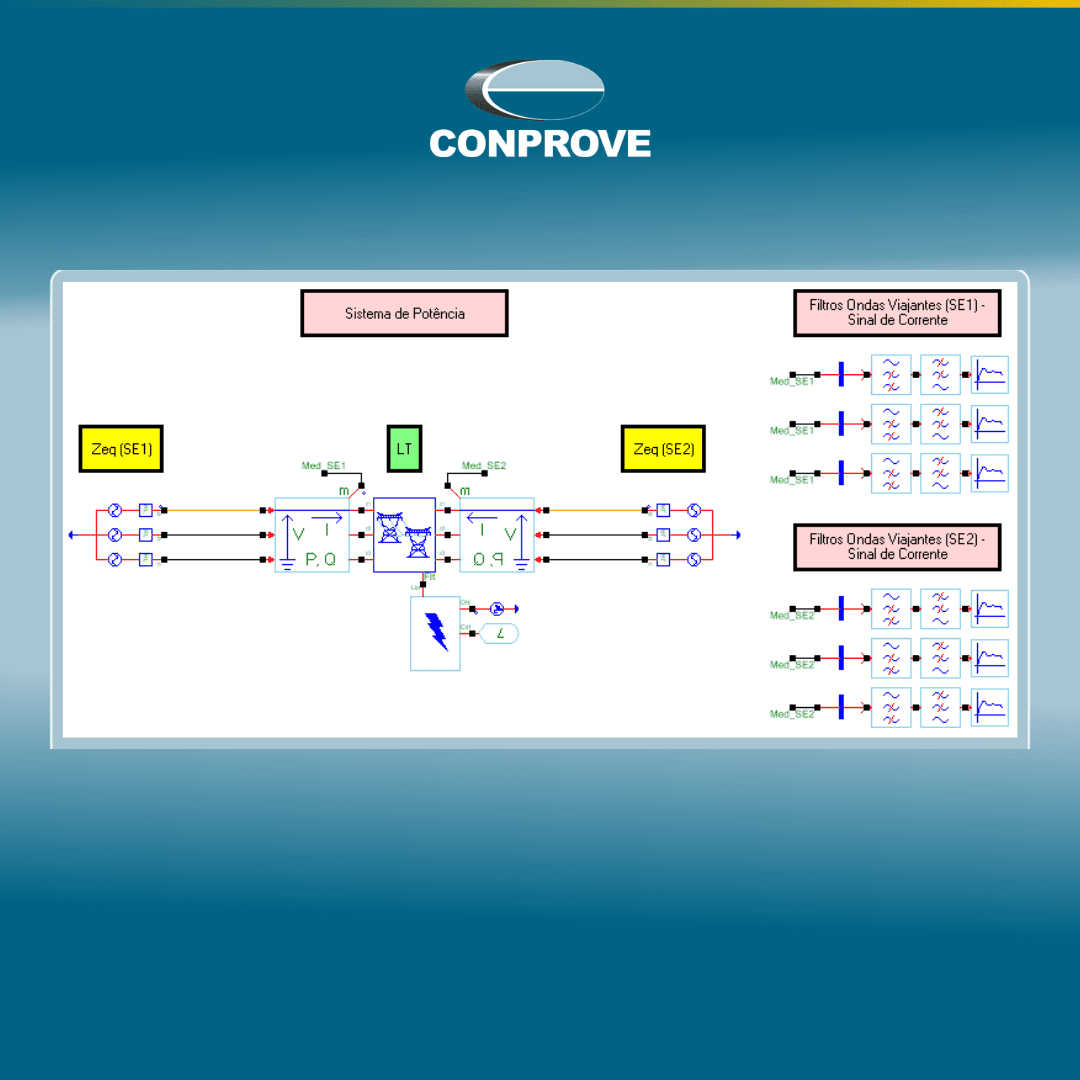
In this example, the system shown in the figure below was modeled, and a contingency was simulated 20 km from SS1 at time t=1 ms.
Attachment:
Comentário sobre o Arquivo: Fig. 2 – Sistema modelado no software PS Simul.

The voltage and current waves propagating along the line can be seen in the graphs below.
Attachment:
File comment: Fig. 3 – Waveforms obtained after the fault on the transmission line.

It is possible to estimate the fault distance relative to the measurement terminal using the equation already mentioned in this publication. For the contingency in this example, the propagation time (calculated by the software) is approximately 268.082 µs, so the propagation velocity is:
v=80 km268.082×10−6 s=298416.15 km/s
Considering substation SS1 as reference, the difference between T2 and T1 is approximately 135 µs. Therefore, the fault distance is:
d=135×10−6⋅298416.152=20.14 km
That is, approximately 25% of the 80 km transmission line length.
In order to enable graphical analysis of traveling waves, PS Simul provides the Bewley/Lattice diagram, which for this example is shown below. In this diagram, the user can position the cursors through simple analysis of the filtered waveforms at both terminals. The waveform filtering can be carried out externally (through the software’s control components) or directly in the Bewley/Lattice graph itself, since the graph includes this feature.
Attachment:
File comment: Fig. 4 – Analysis of fault location using the Bewley/Lattice diagram.

FIG. 4 – RES-BEWLEY.png [ 51.98 KiB | Viewed 50358 times ]
OTHER EXAMPLES AND POSSIBILITIES
In addition to the examples mentioned in this publication, the software provides others that can be accessed through the Support -> Examples tab. For this reason, we recommend downloading the FREE version to explore both the available components and the ready-made examples. Our technical support team is available to answer any questions related to PS Simul software.
Feel free to send your suggestion if there is any study of interest that is not among the examples highlighted here.