





Power systems are constantly exposed to transient phenomena capable of imposing significant electrical stress on network equipment and infrastructure. Short circuits, lightning strikes, circuit breaker switching operations, and transformer energization are just a few examples of events that can generate high-frequency electromagnetic transients.
In this context, Electromagnetic Transient (EMT) Modeling has become an indispensable tool for advanced electrical engineering studies, enabling engineers to analyze the dynamic behavior of power systems and anticipate potential operational risks.
Computational tools such as PS Simul and ATP (Alternative Transients Program) play a fundamental role in these analyses, allowing detailed simulations in both the time and frequency domains.
What Are Electromagnetic Transients?
Electromagnetic transients are fast and temporary phenomena that cause abrupt variations in voltage and current within a power system.
These events may occur due to:
- Short circuits
- Transformer energization
- Switching operations
- Lightning strikes
- Network faults
- System oscillations
Although they occur over very short time intervals, their impacts can be significant on equipment and protection systems.
The Importance of EMT Studies
Electromagnetic transient studies help engineers understand how power systems respond to fast and complex events.
These analyses are essential for:
- Equipment protection
- Insulation coordination
- Overvoltage assessment
- Switching transient analysis
- Protection system validation
- Operational reliability studies
Accurate modeling helps prevent failures and improve system operational safety.
Main Phenomena Analyzed
Among the most common phenomena evaluated in EMT studies are:
Short Circuits
Electrical faults can generate severe transients that affect:
- Fault currents
- System stability
- Protection operation
- Equipment integrity
Transformer Energization
Transformer energization can produce high inrush currents caused by magnetic core saturation.
This phenomenon may:
- Trigger unwanted protection operations
- Generate harmonic distortion
- Affect protection selectivity
Circuit Breaker Switching Operations
Switching operations may produce:
- Transient overvoltages
- Fast oscillations
- Wave reflections
- High-frequency transients
Lightning Strikes
Lightning is one of the primary sources of overvoltages in power systems.
Its effects may cause:
- Insulation breakdown
- Equipment damage
- Operational failures
- Power supply interruptions
Modeling Power System Components
Transient studies require detailed representations of power system components.
Modeling may include:
- Transmission lines
- Cables
- Transformers
- Generators
- Circuit breakers
- Grounding systems
Depending on the study objectives, components can be represented using:
- Lumped parameters
- Distributed parameters
- Frequency-dependent models
Transmission Line Modeling
Transmission lines play a critical role in transient studies due to electromagnetic wave propagation.
They are frequently modeled using:
- Nodal admittance matrices
- Phase-domain models
- Distributed parameter models
This approach provides greater accuracy in representing transient phenomena.
Transformer Saturation and Inrush Current
Magnetic core saturation is a critical aspect of transformer energization studies.
Inrush currents may exhibit:
- High amplitudes
- Strong harmonic content
- Asymmetrical behavior
Therefore, transformer models must consider the nonlinear effects of magnetic saturation.
Computational Tools for EMT Studies
Modern transient studies rely heavily on advanced simulation software.
Among the most widely used platforms are:
- PS Simul
- ATP (Alternative Transients Program)
These tools enable:
- Dynamic simulation
- Detailed modeling
- Time-domain studies
- High-frequency transient analysis
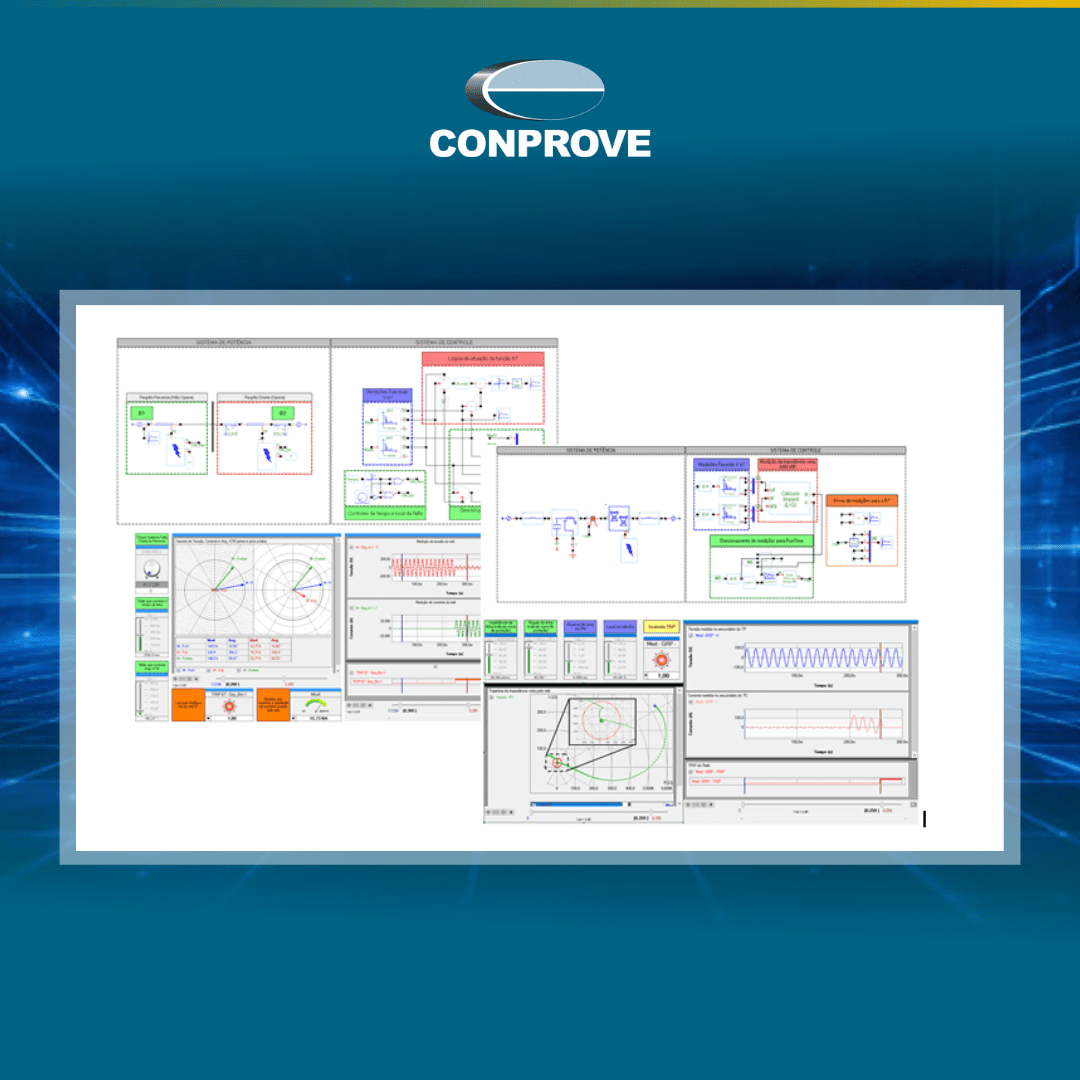
PS Simul: A Brazilian Solution for Power System Simulation
PS Simul, developed by CONPROVE, offers advanced resources for:
- Power system modeling
- Electromagnetic transient simulation
- Protection studies
- Stability analysis
- Dynamic assessment of electrical systems
The software helps engineers and researchers analyze complex scenarios in modern power engineering.
Benefits of Electromagnetic Transient Studies
EMT studies provide:
- Greater operational reliability
- Reduced risks
- Improved protection coordination
- Better asset protection
- Enhanced substation safety
- Reduced failures and outages
They also support decision-making during:
- Project development
- System expansions
- Commissioning activities
- Engineering studies
The Importance of Simulation in Modern Engineering
As power systems become increasingly complex, simulation has become an essential part of power engineering.
Computational analyses enable engineers to:
- Anticipate problems
- Validate designs
- Simulate critical conditions
- Improve protection strategies
This results in lower operational costs and greater system reliability.
Learn More About PS Simul
CONPROVE: Technology Applied to Electrical Engineering
For more than 40 years, CONPROVE has been developing solutions for:
- Power system simulation
- Electrical protection
- IEC 61850
- Substation automation
- Protection testing
- Specialized technical training
The company is recognized throughout Latin America as a reference in technologies applied to power systems.