




Network Monitoring in Digital Substations Based on IEC 61850
What is Network Monitoring?
The basic concept of network monitoring involves the systematic verification of network activity to detect anomalies that may compromise its proper operation. Therefore, monitoring the IEC 61850 network is essential throughout the entire lifecycle of a digital substation. This means monitoring should be performed during commissioning stages such as the Factory Acceptance Test (FAT) and Site Acceptance Test (SAT), as well as during maintenance testing.
Why is Network Monitoring Important in Digital Substations?
The importance of network monitoring is linked to early error detection, the network’s operational conditions, reduction of network downtime by tracking problematic elements, logging of all network events, and ensuring the power system’s security and stability. Specialized devices are required to monitor these aspects, functioning as “network oscillographs” or “digital network recorders.” Such monitoring systems must be implemented in both hardware and software to meet the time-critical requirements of GOOSE and Sampled Values (SV) protocols.
Various network aspects must be analyzed to ensure the security, reliability, speed, and availability of the transmitted information, warning of potential communication failures or intrusions. These aspects include message integrity, data configuration and security, system time synchronization, and message timing statistics, such as frame interval, transfer time, and packet loss.
What are the Brazilian TSO (“ONS”) best practices?
The Brazilian TSO best practices involve monitoring and enforcing rules established for operating interconnected power system. These rules cover everything from relationships with agents to operational assessments and the integration of new installations. The Brazilian TSO is responsible for coordinating and controlling the operation of power generation and transmission, with these best practices guide forming the foundation of its work.
In detail, the the best practices define the rules for system operation, including criteria, requirements, responsibilities, and operational procedures to ensure the safety and efficiency of the power system. They cover all stages of operation, establish the interface between agents and the Brazilian TSO, and are divided into modules and submodules.
Revision of Submodule 2.11 of the Best Practices Guide
“Submodule 2.11 – Minimum Requirements for Protection, Disturbance Recording, and Teleprotection Systems” was revised and approved on 05/21/2024. The document’s objective is to establish minimum technical requirements and functional characteristics for protection, disturbance recording, teleprotection systems, and communication networks used for protection. These minimum technical requirements apply to all power transmission facilities that are part of the interconnected power system.
Specifically, item 7 of Submodule 2.11 addresses Networks Used for Protection and states that the following failure modes must be continuously monitored and signaled by the monitoring system or device, according to the substation configuration:
(a) loss of message integrity;
(b) absence of expected messages;
(c) absence of synchronization signals;
(d) presence of unexpected messages;
(e) abnormal intervals between expected messages;
(f) abnormal message propagation time (latency).
Additionally, it covers other relevant points such as requiring network monitoring functions to be based on hardware and software independent from the protection devices being monitored. The monitoring systems must also have the capability to store anomaly event logs in standardized formats.
CONPROVE Solution for Network Monitoring and Diagnostics in IEC 61850-Based Digital Substations
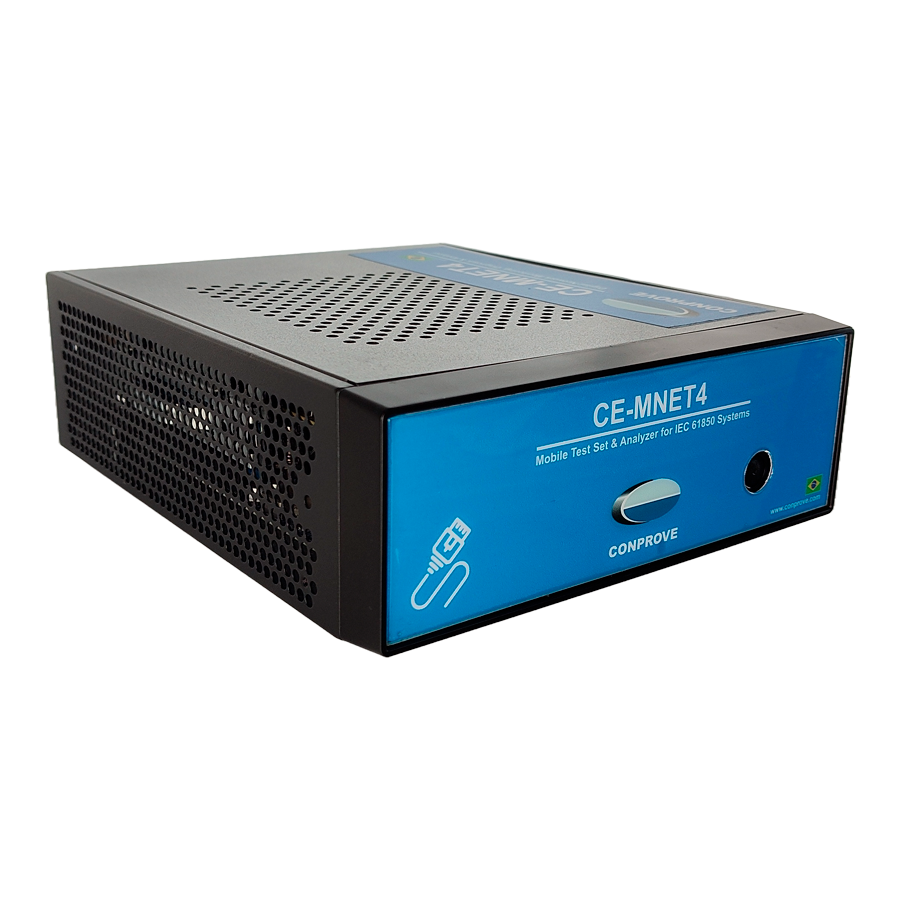
The CONPROVE network monitoring and diagnostic system is designed to meet — and exceed — the minimum requirements described in the Brazilian TSO best practices guide. The solution features a fully user-friendly and intuitive interface, offering multiple functionalities that make the system extremely powerful, yet easy to operate and self-explanatory. CONPROVE offers a versatile solution with versions available both for rack installation (CE-RNET4) and in portable format (CE-MNET4). The system is designed to perform continuous communication network monitoring.
Key operating modes include:
SCL Validation Mode: compares the imported SCL with the actual network traffic;
“Unexpected Traffic” Mode: identifies network traffic not defined in the SCL file;
Statistics Mode: performs statistical analysis of GOOSE and Sampled Values traffic;
Supervision/Monitoring Mode: detects network errors through various supervision events using a hybrid method (sniffer and MMS). It monitors GOOSE, Sampled Values, PTP, PRP, Logical Nodes of IEDs (via MMS), and the monitoring device itself. Network failure event logs are saved in PCAP format. Finally, alarms from these failure events can be sent to the SCADA system via MMS.
The system includes 4 SFP network ports (1 Gbps) for testing, diagnostics, and monitoring, one dedicated SFP port for PTP synchronization, and two additional RJ45 ports for communication, MMS, and technical support.